



Royal Fortress of Chinon: Historical Visitor’s Guide
Chinon
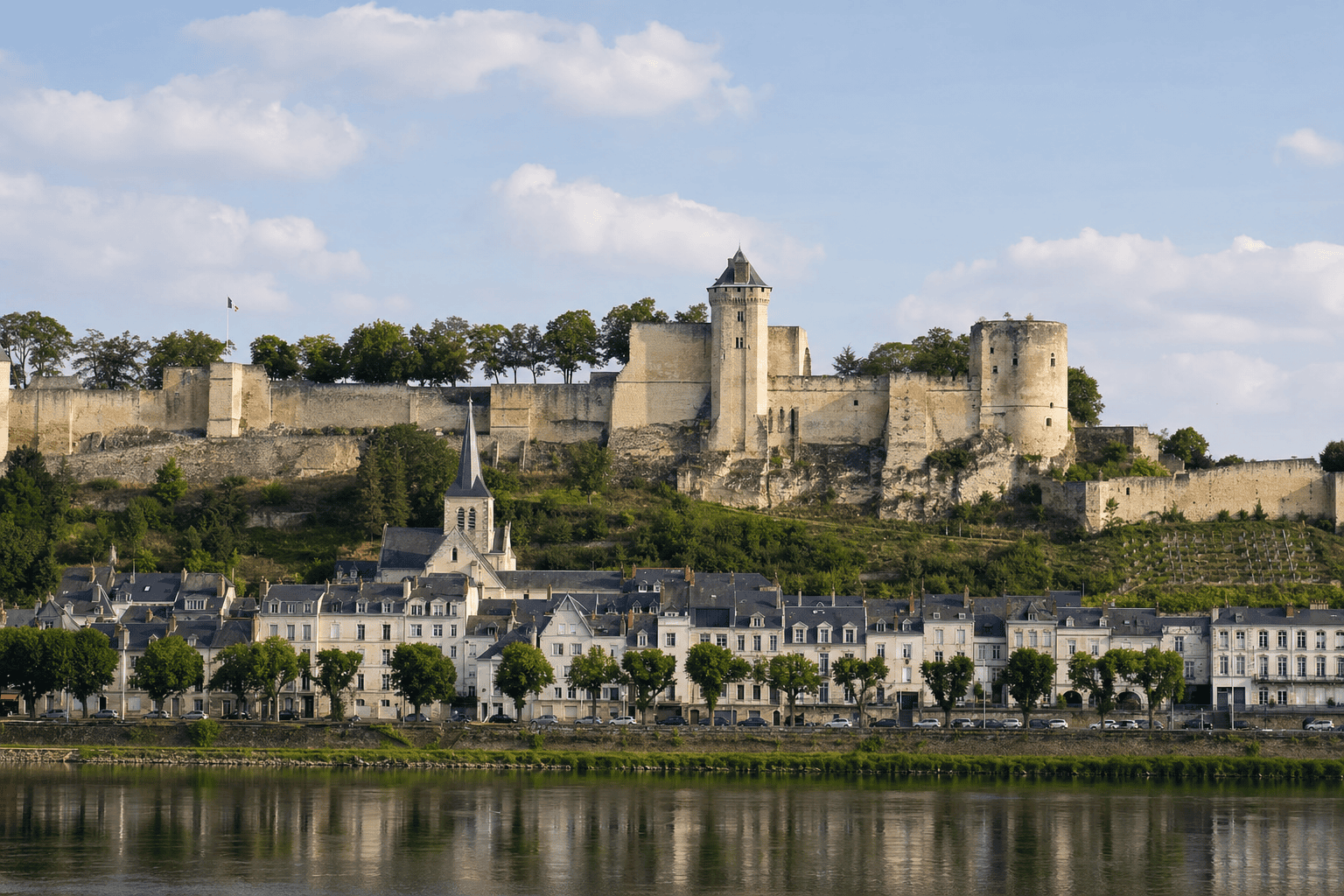
Perched on a rocky spur overlooking the town of Chinon, the Royal Fortress of Chinon is one of the Loire Valley’s major medieval sites. Its walls stretch for more than 500 meters and encompass three fortified sections: Fort du Coudray, Château du Milieu, and Fort Saint-Georges. The visit traces several centuries of history, from the Plantagenets to Charles VII, including one particularly famous episode: Joan of Arc’s arrival in Chinon in February 1429. Beyond its walls and restored buildings, the site captivates visitors with panoramic views of the Vienne, the rooftops of the historic town, and the vineyards of the Chinonais region. Allow plenty of time to explore the different levels, admire the towers, and continue your discovery through Chinon’s medieval streets.
Practical information
After your visit, walk down to Chinon’s historic center and continue along the Vienne riverbanks to admire the fortress from a different angle.
Travel from Paris to Chinon by private car with driver
For a private excursion from Paris, Booking Paris Transfer can arrange round-trip transportation to Chinon from your Paris hotel, CDG, or ORY. The service covers transportation only: admission to the Royal Fortress of Chinon must be arranged separately through the official site. Depending on your itinerary, you can return to Paris the same day or include Chinon in a cultural tour of the Loire Valley.
Transportation from Paris, a Paris hotel, CDG, or ORY; admission ticket not included.
Understanding the fortress’s history
The Royal Fortress of Chinon occupies a strategic position above the Vienne. Its history is shaped by rivalries between the kingdoms of France and England, as well as by the power of the Plantagenets, whose possessions extended across much of western France. In the 12th century, Henry II Plantagenet and later his son John Lackland gave the site part of its present-day military profile. The walls, towers, and buildings reflect a fortress that served as both a seat of power and a defensive stronghold.
In the 15th century, Chinon became an important location for the dauphin Charles, the future Charles VII, during the Hundred Years’ War. This is where Joan of Arc came to meet him in 1429, urging him to continue reclaiming the kingdom and be crowned at Reims. This now-iconic meeting gives the monument a political and national dimension. The visit therefore connects the architecture with the major transformations of the Western Middle Ages.
The three castles to explore
The fortress is not a single castle organized around one courtyard. It is a vast complex made up of three distinct sections, separated by dry moats and defensive structures. To the west, Fort du Coudray retains a more military atmosphere and evokes the spur’s first line of defense. Château du Milieu forms the central section most closely associated with the royal residences and court life. To the east, Fort Saint-Georges completed the complex’s defenses and controlled access from the plateau.
This layout explains what makes the visit so interesting: the route alternates between open spaces, walls, towers, and enclosed buildings. Be prepared to walk and regularly change levels to understand the site’s topography. Take time to observe how the three enclosures relate to one another rather than focusing only on the restored rooms. The fortress can be read as a military landscape, with each section serving a precise purpose.
Joan of Arc and Charles VII in Chinon
Chinon’s best-known episode is Joan of Arc’s visit to the dauphin Charles. Arriving in Chinon on February 23, 1429, after a long ride, she sought his support to lift the siege of Orléans and lead the French monarchy toward its coronation at Reims. The meeting took place amid war, a crisis of legitimacy, and deep political uncertainty. The fortress thus became the setting for a decisive moment in the history of the kingdom.
On-site interpretation materials help place this episode in its historical context without reducing the visit to a simple legend. The areas associated with the royal residences evoke the presence of a traveling court, while the fortifications recall the fragility of a power base in a contested region. For families, this narrative dimension makes the route especially accessible: you can follow the characters, stakes, and movements while observing the buildings. The visit is well complemented by a stroll through old Chinon, where the medieval past remains highly visible.
Military architecture and royal residences
The Royal Fortress of Chinon offers a chance to observe several generations of defensive architecture. The towers, curtain walls, gates, and ditches are not arranged at random: they follow the shape of the spur and use the terrain to reinforce the site’s natural protection. Walking along the ramparts makes it easier to understand how a fortress controlled access, monitored the valley, and organized movement between its different enclosures.
The contrast between the ruins, surviving elevations, and restored buildings is one of the site’s great charms. The royal residences evoke a residential and political function very different from the image of a castle devoted solely to warfare. Reconstructions and interpretation tools help visitors imagine the vanished spaces, everyday life, and the presence of the court. Pay particular attention to the thickness of the masonry, defensive openings, and differences in materials. The pale stone, traces of alterations, and irregularities in the construction reveal the monument’s successive transformations.
Panoramic views of Chinon and the Vienne
The views are one of the main reasons to visit the fortress. From the ramparts and high points, you can take in Chinon’s rooftops, the Vienne Valley, and the landscapes of the Chinonais region. Its elevated position immediately explains why this spur was chosen: the site monitored movement through the valley while providing a natural defense that was difficult to bypass.
The views change depending on where you stand. From inside the enclosure, the medieval town appears as a compact cluster dominated by towers. Descending toward the riverbanks or reaching the viewpoints on the opposite bank reveals the fortress in its full length, backed by the hillside. Photography enthusiasts will want to choose soft light, in the morning or late afternoon, to better distinguish the landforms and rooftops. The interpretation trail on the northern slope also offers a different perspective on the ramparts; however, check the official information, as some sections may be temporarily inaccessible.
Planning an enjoyable visit to Chinon
A comfortable visit starts with suitable footwear. The route includes changes in elevation, stairs, and uneven surfaces, while several areas are exposed to sun and wind. In summer, bring water and sun protection; in spring or fall, a light jacket can be useful on the ramparts. Families can pace their visit by alternating between outdoor spaces, towers, and interpretation areas.
Opening hours vary throughout the year, and the ticket office may close before the site itself. The fortress states that it is open year-round, with exceptions announced on its practical information pages; therefore, check the official information on the day of your visit. Activities, guided tours, and digital exhibits may also vary by season. For a first visit, allow at least two hours, or longer if you want to read the displays, enjoy the viewpoints, and follow the outdoor trail. From the fortress, walking down to the historic center is a natural way to continue your day among old houses, shopping streets, and the Vienne riverbanks.
What to see around the fortress
The Royal Fortress of Chinon deserves to be part of a full day in the town. Below, the historic center preserves half-timbered houses, tuffeau stone façades, and streets that recall the town’s medieval role. A walk along Rue Voltaire and through the former neighborhoods offers a change of scale after the vast ramparts. The Vienne riverbanks then provide a more open perspective of the fortress and make for a pleasant walking route.
The surrounding area also extends the Loire Valley experience. Chinon’s vineyards are closely connected to the landscapes seen from the hillside, and several estates offer tours or tastings by reservation. Heritage enthusiasts can include the fortress in an itinerary featuring Fontevraud Abbey, villages along the Loire, or other châteaux in the Centre-Val de Loire region, checking travel times and opening conditions. For an excursion from Paris, plan realistically: the distance often makes it worth dedicating a full day, or more, to Chinon and its surroundings.
Frequently Asked Questions
How much time should you allow to visit the Royal Fortress of Chinon?
What are the fortress’s three sections?
Is the fortress associated with Joan of Arc?
Are the hours and prices fixed?
What can you do after the visit?
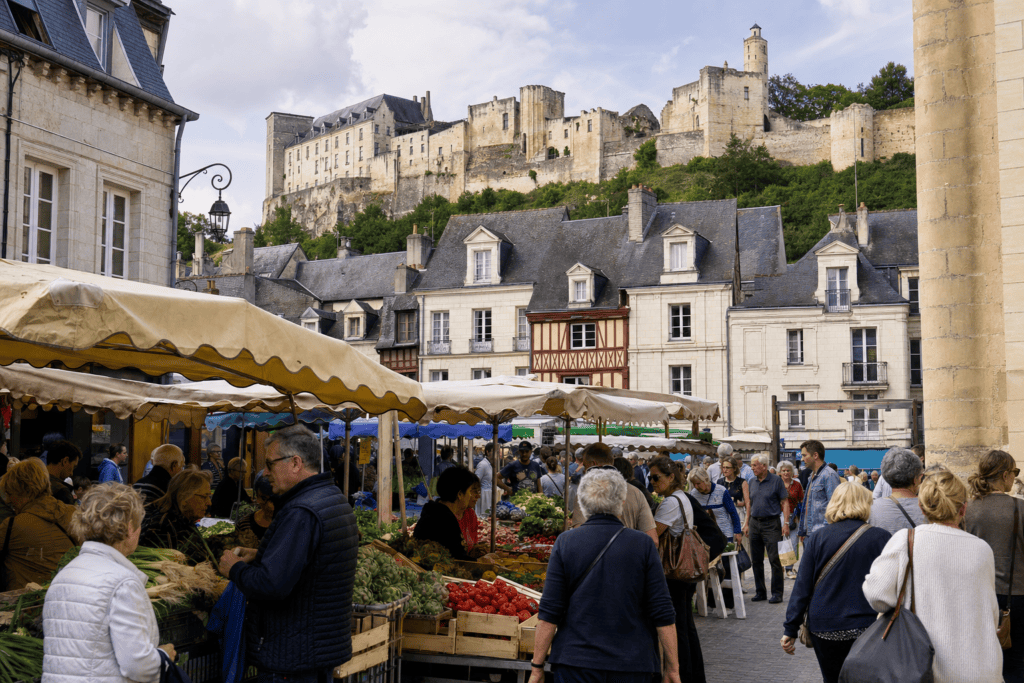 Chinon Market A Thursday morning market where you can sample Touraine products and continue your stroll through…
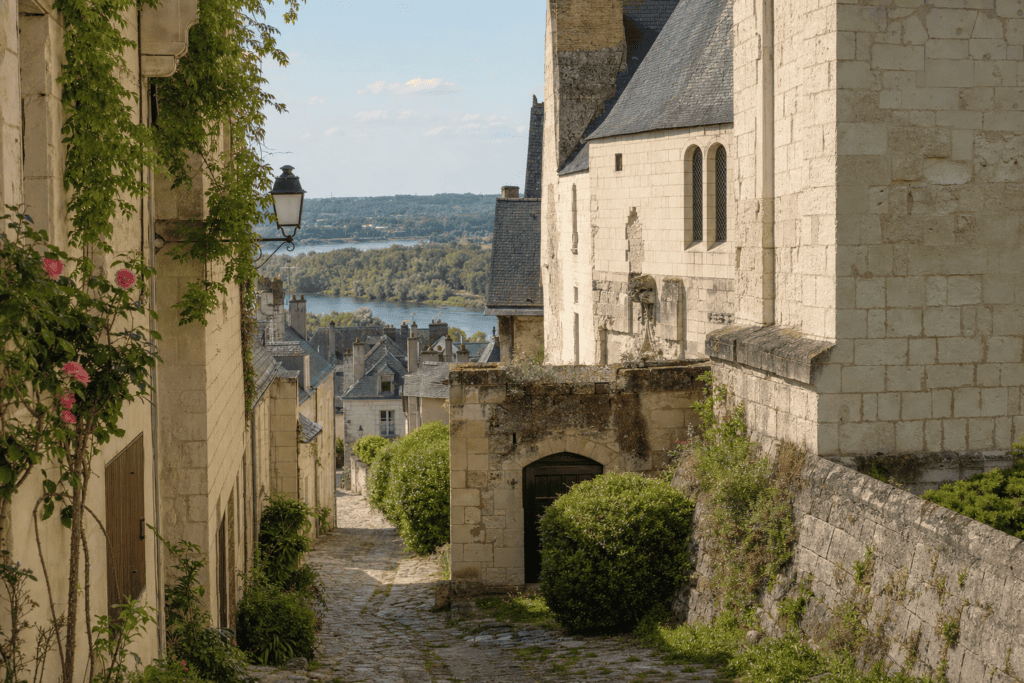 Medieval Old Town of Chinon A charming route through Chinon’s historic center, among half-timbered houses…
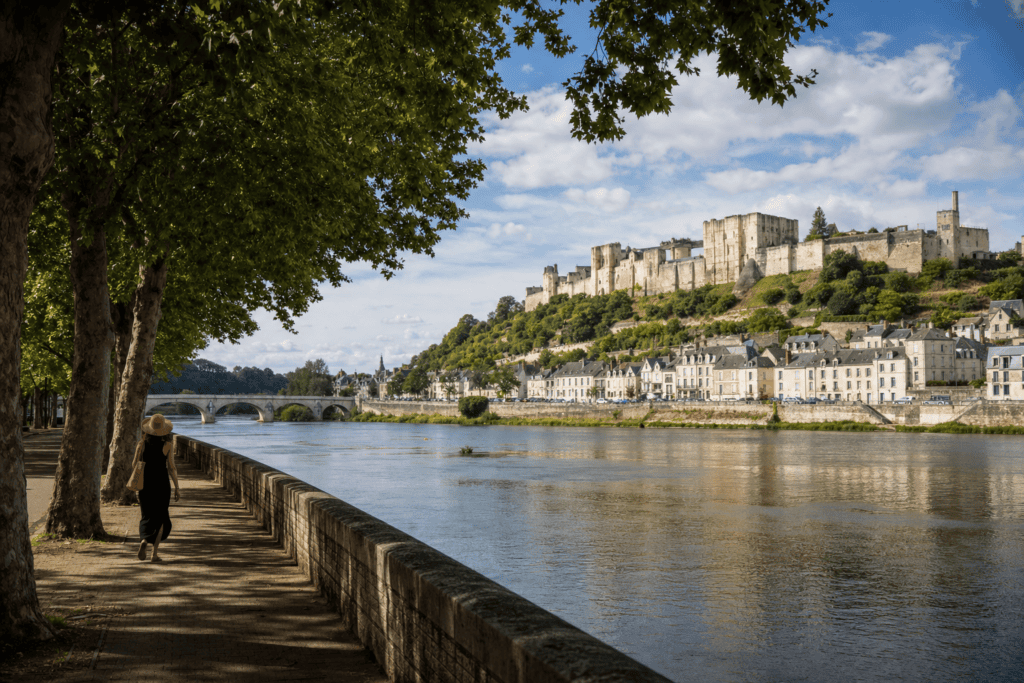 Vienne River Quays and Chinon Promenade A riverside walk along the Vienne offering beautiful views of the fortress…
 Chinon Wine Tasting Explore the red, rosé, and white wines of the Chinon appellation, meet the winemakers, and discover the region’s terroirs…
Online booking · Paris → Royal Fortress of Chinon, 37500 Chinon, Indre-et-Loire, Centre-Val de Loire
Choose your pickup date and time
Your departure and arrival details are already pre-filled. You can adjust them in the fare calculator before viewing the vehicles and fare.