



Rennes Historic Center: The Old Town on Foot
Rennes
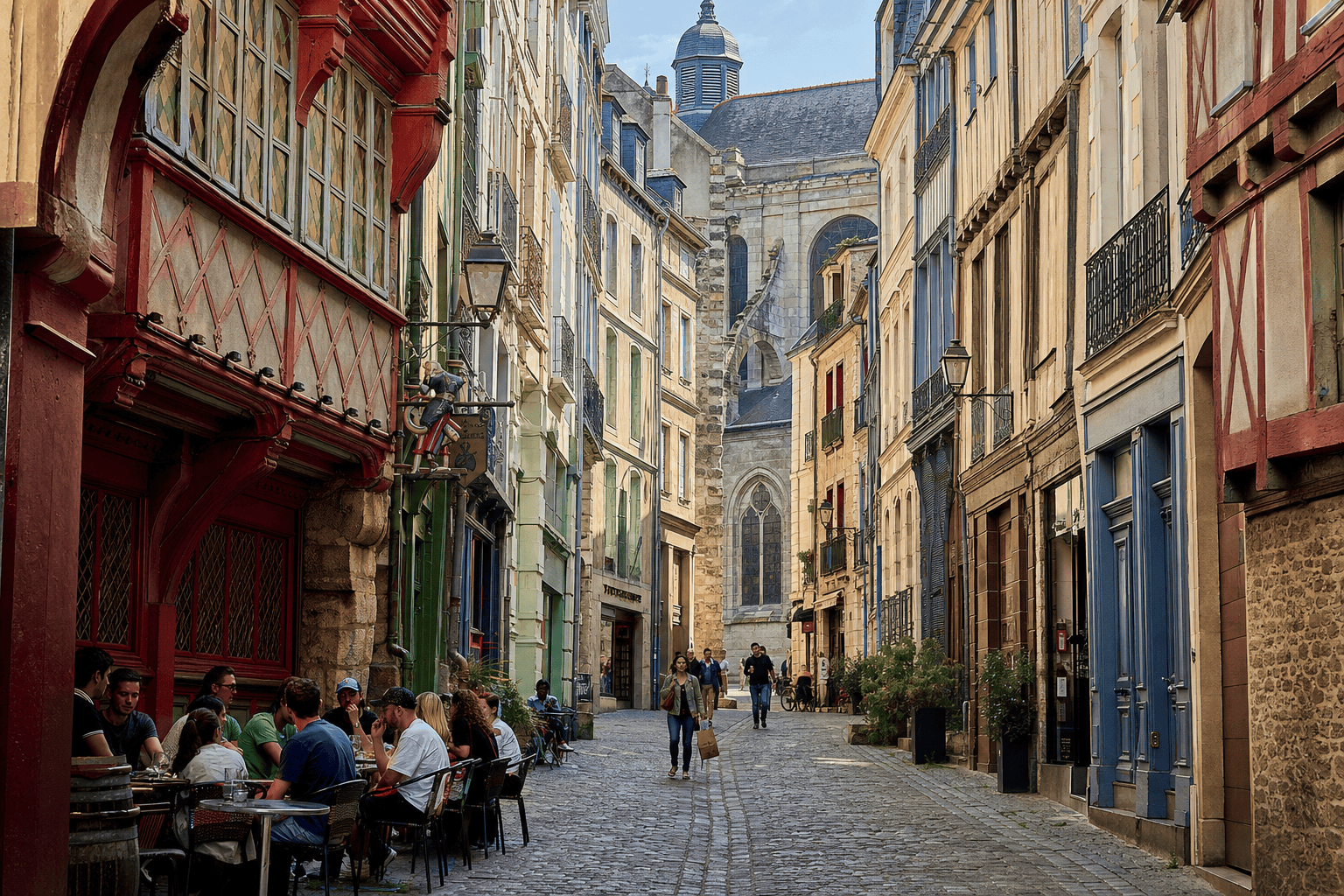
Rennes’ historic center is best discovered at a leisurely pace, without following an overly rigid itinerary. Between colorful half-timbered houses, private mansions, squares lined with terraces, and cobbled streets, every turn reveals another chapter in the history of Brittany’s capital. This urban route connects the main landmarks of Old Rennes while letting you enjoy the cafés, independent shops, and food spots that give the neighborhood its lively atmosphere.
Practical information
Look up regularly: the most interesting details are often found on the upper floors, in the overhangs, carved decorations, and colorful patterns of the façades.
Getting to Rennes from Paris by private transportation
For a getaway to Rennes’ historic center, Booking Paris Transfer can arrange private transportation from Paris, a Paris hotel, Charles de Gaulle or Orly Airport, with a return to Paris or continuation of your itinerary in Brittany. The vehicle drops you off in Rennes so you can begin your walk; admission tickets and a local guided tour are not included.
Departure is possible from Paris, the Île-de-France region, CDG or ORY, by reservation.
Start your walk around the cathedral
For a first introduction, start near Saint-Pierre Cathedral, west of the old town. This area provides quick access to the pedestrian streets and lets you experience the contrast between religious buildings, granite façades, and narrower historic houses. Take time to admire the views along Rue Saint-Sauveur, Rue du Chapitre, and the nearby passages before continuing toward Place Sainte-Anne.
The historic center is not a frozen-in-time museum: its ground floors are home to cafés, restaurants, bookstores, and shops, while the upper floors retain many historic features. Exploring independently works very well, but a guided tour organized by the tourist office can provide useful insight into the evolution of the streets, the fires, and the restoration work. To avoid missing the details, wear comfortable shoes and take your time rather than trying to see everything in one visit.
Admire the half-timbered houses
Half-timbered houses are one of the main highlights of Rennes’ historic center. The city preserves several hundred of them, particularly in areas that escaped the Great Fire of 1720 or were later restored. The term “half-timbered” is more precise than “colombage” when describing Rennes’ architecture. Look at the overhangs: the upper floors sometimes project over the ground floor, giving the streets an irregular and highly photogenic silhouette.
Rue du Chapitre is an excellent place to observe them. Colorful façades, geometric patterns, and carved decorations stand alongside stone private mansions. Rue Saint-Georges also offers fine examples, including the Hôtel de la Moussaye, recognizable for its width and Renaissance-style decoration. Photograph the details without disturbing residents: several buildings are privately owned, and interior courtyards are accessible only as part of a tour or with the occupants’ permission.
Stroll along Rue du Chapitre
Rue du Chapitre is one of the most pleasant streets in Old Rennes. Quieter than some of the shopping streets, it brings together half-timbered houses, private mansions, boutiques, and tables where you can take a break within just a few dozen yards. It is a street to explore slowly, alternating between admiring the façades and stopping at the small shops.
At number 5, the Hôtel de l’Escu de Runfao stands out for its polychrome decoration and geometric forms. Farther along, other façades reflect the neighborhood’s successive transformations: some houses have been raised, altered, or combined with stone buildings. This diversity is precisely what makes the walk interesting. Rather than looking for a perfectly uniform setting, try to read the differences in materials, proportions, and decoration. Rue du Chapitre is especially enjoyable in the late morning or early evening, when the terraces begin to come alive.
Understand the history at Place du Champ-Jacquet
Place du Champ-Jacquet is one of the most recognizable spots in the historic center. Its half-timbered houses sometimes seem to lean toward one another, creating a silhouette that has strongly shaped Rennes’ image. This impression should not be seen as merely picturesque: it also reflects the construction history of the old buildings, their alterations, and the flexibility of wooden structures.
The square is particularly useful for comparing two periods of urban development. On one side, façades dating from before the 1720 fire remain; on the other, stone buildings recall the rebuilding and the shift in architectural taste that followed the disaster. At the center, the statue of Jean Leperdit adds a historical and political dimension to the site. Sit for a few minutes on a terrace or bench and study the lines of the façades. The best viewpoint is not necessarily straight on: moving into Rue Leperdit gives you a better sense of the perspective.
Make your way to Place des Lices and its market
As you continue toward Place des Lices, the walk opens up. This spacious square is home to the Martenot market halls, terraces, and several notable private mansions. It is known for its Saturday morning market, an institution in Rennes’ daily life that gives the neighborhood a particularly lively atmosphere. If you come that day, allow extra time to browse the stalls, taste Breton specialties, and take in the square from its surrounding streets.
Look up at the twin Noue and Racapée de la Feuillée mansions, built in the 17th century. Their half-timbered façades illustrate a more regular style of architecture than the medieval houses, with patterns that emphasize symmetry. Other stone private mansions testify to the presence of members of the Parlement of Brittany and administrative elites in Rennes. Place des Lices is a good stop for lunch or coffee, but check the market days and conditions with local sources before you leave, as arrangements may change.
Observe the contrast between stone and wood
Rennes’ historic center is more than its colorful houses. Its appeal comes from the ongoing dialogue between wood, granite, tuffeau stone, and plaster. The 1720 fire destroyed much of the city and led to a reconstruction based more extensively on stone. This history is especially clear around Place du Parlement de Bretagne, Place de l’Hôtel de Ville, and the streets connecting them.
As you walk, compare the flat, orderly façades of the reconstructed buildings with the more irregular forms of the older houses. Private mansions often feature carriage entrances, courtyards, and carefully selected materials, while half-timbered houses reveal a different way of occupying the lot and the street. The neighborhood also preserves more recent features, such as some 20th-century mosaics and decorations. This layering makes the route rewarding for architecture enthusiasts: Rennes is less a single setting than a succession of urban strata.
Continue your walk between heritage and everyday Rennes
After the main squares, let the streets guide you rather than following an exhaustive list of monuments. Rue Saint-Michel, Rue Saint-Georges, Rue Saint-Louis, and the area around Place Sainte-Anne offer different atmospheres, blending historic façades, food spots, and nightlife venues. The historic center suits different paces: a quick two-hour loop, a half-day with breaks, or a deeper exploration with a guided tour and access to certain interiors.
Be considerate of residents, especially in narrow passages and outside occupied buildings. Visitors with reduced mobility should plan their route with cobblestones, slopes, and possible construction work in mind. In changeable weather, museums, cafés, and monuments can provide useful breaks, but their hours and arrangements vary: check official websites before setting out. From Paris, Rennes is also well suited to a round-trip private transportation getaway, while allowing you to start exploring as soon as you arrive in the city.
Frequently Asked Questions
How long does it take to visit Rennes’ historic center?
Where can you see the best half-timbered houses in Rennes?
Is the Lices market held every day?
Can you visit the interior courtyards of the private mansions?
Is the historic center accessible with strollers and wheelchairs?
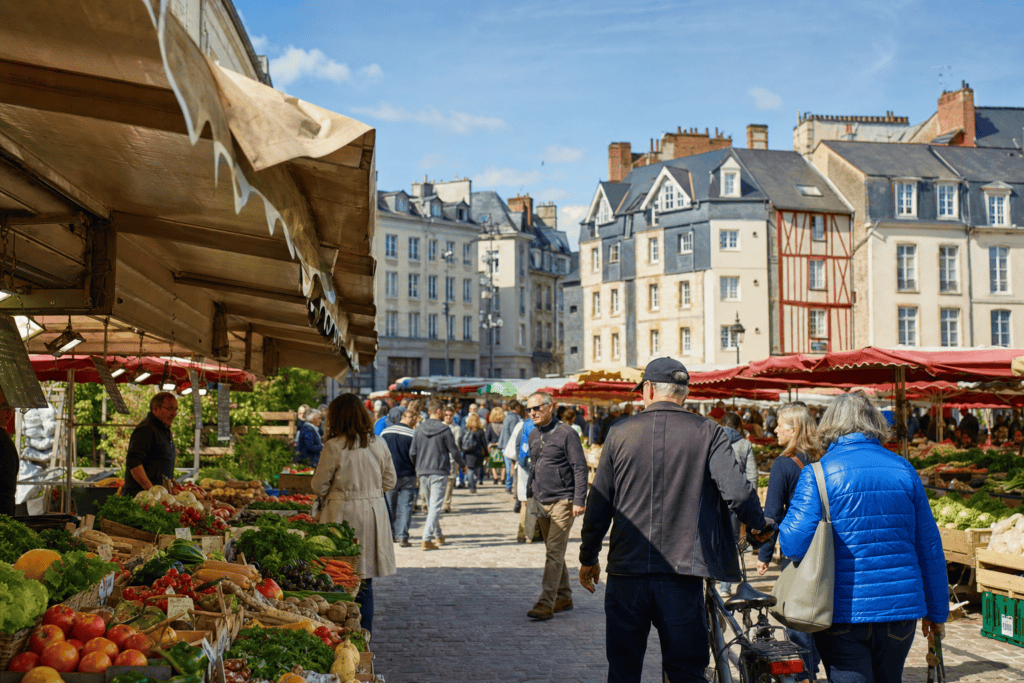 Marché des Lices On Saturday mornings, discover the stalls, the Halles Martenot, and the famous galette-saucisse in the historic center…
 Thabor Park A nearly ten-hectare public garden in Rennes featuring a rose garden, botanical garden, waterfalls, aviary, and…
 Parliament of Brittany A historic palace in central Rennes, famous for its Grand’Chambre, restored decorations, and…
 Les Champs Libres A major cultural hub in Rennes bringing together a museum, science facilities, a library, exhibitions, lectures, and a planetarium.
Online booking · Paris → Rennes Historic Center, Rennes, Ille-et-Vilaine, Brittany
Choose your pickup date and time
Your departure and arrival details are already pre-filled. You can adjust them in the fare calculator before viewing the vehicles and fare.