




Bayeux Historic Center: Itinerary and Tips
26 km
Bayeux’s historic center is easy to explore on foot, centered around Notre-Dame Cathedral, historic streets, the Aure riverfront, and museums that tell several centuries of Norman history. For a first walk, start at Place de la Liberté, take in the cathedral, continue along Rue Saint-Malo, Rue des Cuisiniers, and Rue Saint-Jean, then head to the banks of the Aure before returning toward the Tapestry area. Allow about two hours for the urban loop, excluding indoor visits. Bayeux is also a worthwhile stop on an itinerary between Paris and the D-Day beaches, although reaching the beaches requires separate transportation from the walking route.
Practical information
Wear comfortable shoes and bring a waterproof jacket. Use the cathedral, the Aure riverfront, and Rue Saint-Malo as landmarks. The D-Day beaches cannot be reached on foot from the center and require separate transportation.
Paris → Bayeux: Private Transportation for Your Day in Normandy
Booking Paris Transfer arranges private transportation from Paris, a Paris hotel, CDG, or ORY to Bayeux, with a return to Paris or onward travel to Norman sites. The service covers transportation only; tickets, guided tours, and admission fees must be booked separately.
Departure from Paris, the Île-de-France region, CDG, or ORY; return to Paris or onward travel is possible as part of a Norman itinerary.
Understanding Bayeux’s History
Bayeux is a town in Calvados, in the Bessin area at the heart of Normandy. The town is generally identified with Augustodurum, a Gallo-Roman settlement whose remains attest to the area’s long history of habitation. Its importance later grew around the bishopric, commercial activities, and roads linking the Bessin with other Norman territories.
A walk through the town reveals this history in layers. Around the cathedral, religious buildings, stone houses, and historic streets stand alongside areas with timber-framed façades, narrow passageways, and dormer windows. Bayeux suffered less damage than several other Norman towns during the destruction of June 1944, but this does not mean that every building remained intact. Instead, look at the alignments, materials, and differences in height: the historic center’s appeal lies in the coexistence of different periods and functions.
For more information, the official Bayeux town website presents the main heritage and historical landmarks.
Notre-Dame Cathedral, a Landmark of Your Visit
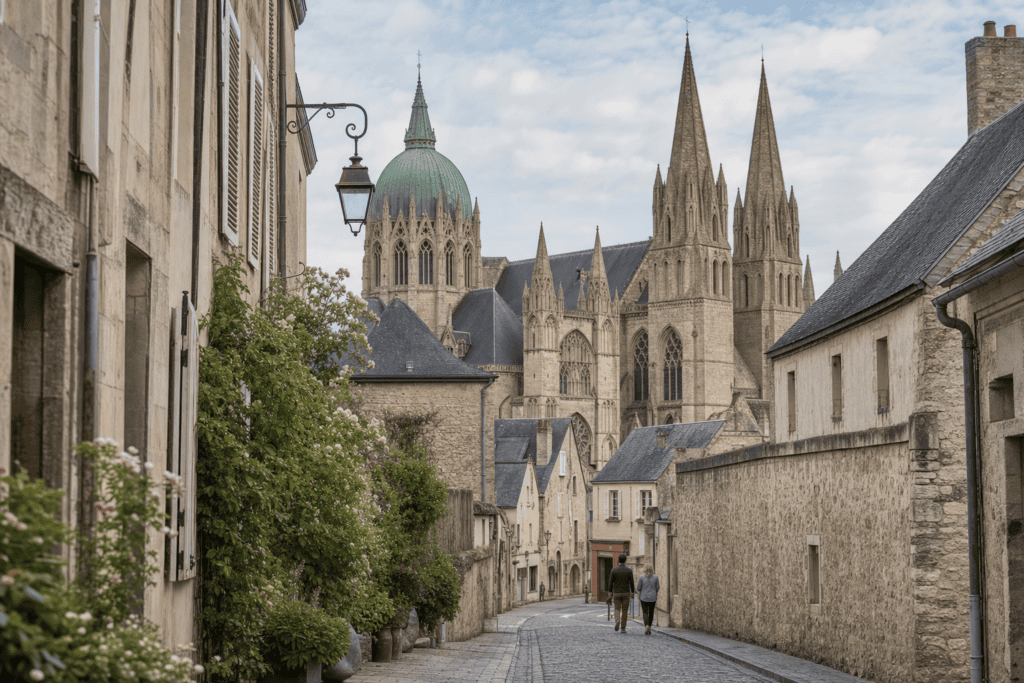
Bayeux’s Notre-Dame Cathedral overlooks Place de la Liberté and is the main starting point for exploring the town on foot. The building reflects several periods of construction and transformation. Visitors can observe Romanesque, Gothic, and later features that illustrate how a major sanctuary evolved over the centuries. The cathedral’s consecration in 1077, in the presence of William the Conqueror according to historical tradition, recalls Bayeux’s religious and political importance in medieval Normandy.
From the forecourt, take time to look at the towers, façade, portals, and variations in the stonework. Inside, the proportions, arches, chapels, and stained-glass windows offer another perspective. The cathedral remains a place of worship: services, ceremonies, and temporary guidelines may affect access. Check the official information before planning an indoor visit.
From the square, Rue Saint-Malo provides a natural route toward the shops and historic houses. Dress modestly and remain quiet when a service is in progress.
Historic Streets and Civilian Architecture
Rue Saint-Malo, Rue des Cuisiniers, and Rue Saint-Jean form an interesting route for observing Bayeux’s civilian architecture. The façades combine timber framing, stone, stucco, narrow doors, and windows of varying sizes. Some houses have been remodeled several times, so a historic building may include features from several periods.
From Place de la Liberté, take Rue Saint-Malo, then continue toward Rue des Cuisiniers and Rue Saint-Jean. This route is only a guide, as construction, events, or temporary restrictions may require a detour. Rather than walking too quickly, look at the passageways, half-timbering, signs, ironwork, and dormer windows. The proportions of the façades are particularly revealing of how the plots and commercial uses have evolved.
Some sections may have cobblestones or uneven surfaces. Visitors with limited mobility should plan their route and ask the tourist office which streets are most suitable on the day of their visit. Also be considerate of residents: the old town is a living neighborhood, not just a heritage backdrop.
The Bayeux Tapestry and the Story of 1066
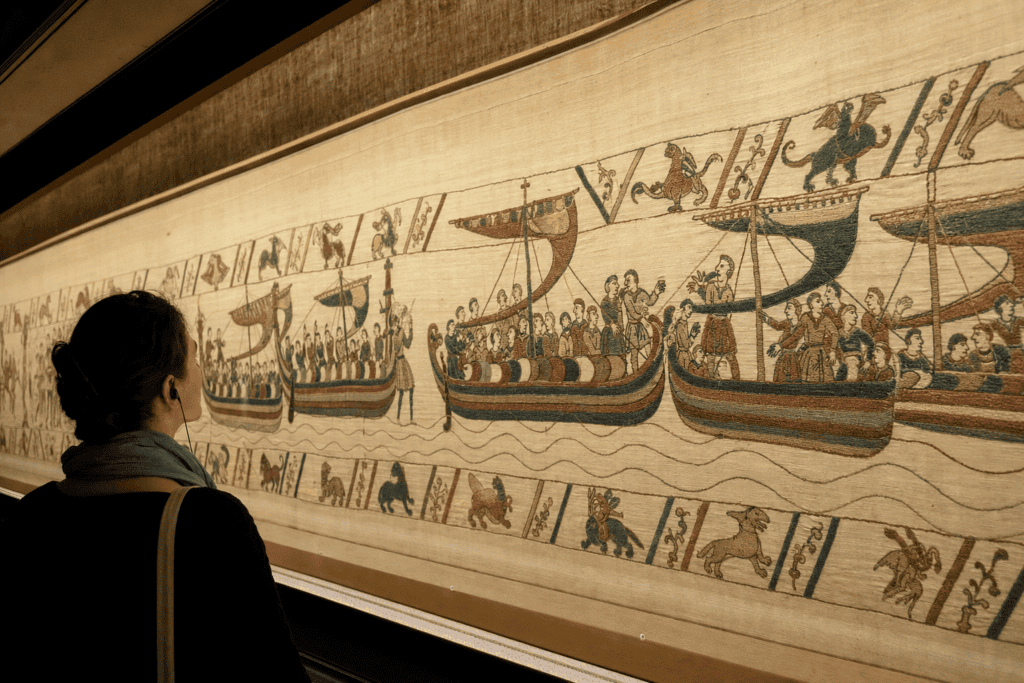
The Bayeux Tapestry is the town’s most famous work. This 11th-century embroideryth recounts the events before and after the conquest of England in 1066. The story begins in 1064 and continues through the Battle of Hastings, while its final section is now missing. The scenes, Latin inscriptions, and borders show how a political and military event could be narrated in the Middle Ages.
The work is traditionally associated with Odo, Bishop of Bayeux and half-brother of William the Conqueror. However, its commissioning, place of production, and the precise identity of its patrons remain subjects of historical debate. The Tapestry is believed to have been kept for several centuries in the cathedral treasury. It is best to distinguish documented facts from hypotheses often repeated in tourist accounts.
The museum devoted to the work complements the town walk, but it is a separate visit with its own hours and arrangements. Consult the official page for the Bayeux Tapestry before traveling, especially if you want to plan your day around a specific time slot.
The Aure Riverfront and Green Spaces
The Aure riverfront offers a change of atmosphere after the more built-up streets of the center. The riverbanks provide water, open views, and a quieter setting. Walls, small bridges, and the backs of buildings can be seen from a different angle. It is a pleasant area for a break or for photographing Bayeux, especially when the light becomes softer. Stay alert near the water and on potentially wet surfaces.
The walk can be extended to the botanical garden, located a reasonable distance from the historic core. This space offers a change of scenery and adds variety to the visit, but its hours, opening conditions, and any seasonal restrictions should be checked before setting out. Travel time depends on your starting point, pace, and chosen detours, so it is best not to promise a fixed duration.
To keep the route simple, return afterward toward the center and the Tapestry area. The riverfront is better suited to a leisurely walk than a quick route; allow extra time if you are traveling with children or want to take photographs.
Bayeux in the Memory of the Liberation
Bayeux holds an important place in the memory of 1944. The town was liberated on June 7, 1944, the day after the Allied landings in Normandy. It then became an administrative center of liberated France, at a time when its condition and location made it an important base. General de Gaulle delivered a speech there on June 14, 1944. These landmarks add another dimension to the visit: Bayeux is more than its medieval heritage and the Tapestry.
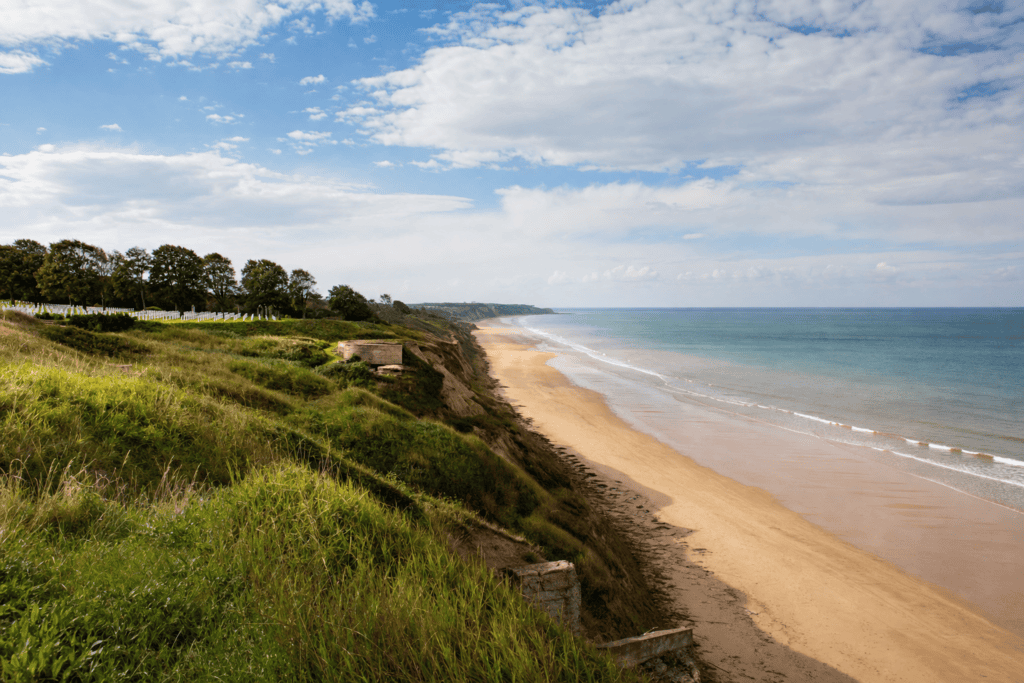
The Memorial Museum of the Battle of Normandy places the town within the military operations and the weeks following June 6. It requires separate visiting time; check its hours and visitor arrangements before going. The D-Day beaches, Arromanches, Omaha Beach, and the American Cemetery at Colleville-sur-Mer are outside the walking loop. They require a vehicle or a separate itinerary.
For historical and practical information, consult the resources of the Normandy Region. A single day can combine Bayeux with several memorial sites, provided you allow for travel distances and visiting time.
Recommended Itinerary and Practical Tips
For a first visit, start at Place de la Liberté in front of Notre-Dame Cathedral. Take in the forecourt and, if conditions permit, spend some time inside the building. Then continue along Rue Saint-Malo, followed by Rue des Cuisiniers and Rue Saint-Jean. Gradually descend toward the Aure riverfront to enjoy a change of scenery, then return toward the center and the Tapestry area.
This loop is compact, but its actual duration depends on stops, photographs, detours, and indoor visits. Allow more time if you want to enter several sites. Comfortable shoes are recommended, along with rain protection, as rain is common in Normandy. Check museum hours and any traffic information before setting out.
From Paris, Booking Paris Transfer can arrange private transportation to Bayeux, with a return to Paris or onward travel as part of a Norman itinerary. This service covers transportation only; admission tickets, guided tours, and museum reservations are separate. Before confirming a day trip, check the travel time, preferred schedules, and duration of each visit. The D-Day beaches should not be added as a simple walking detour from the historic center.
Useful sources
Frequently Asked Questions
How much time should I allow for Bayeux’s historic center?
What walking route should I take in Bayeux?
Is Bayeux’s Notre-Dame Cathedral easy to visit?
How can I check the Bayeux Tapestry visiting conditions?
How can I arrange transportation from Paris to Bayeux?
 Bayeux Tapestry A narrative embroidery from the 11th century recounts William of Normandy’s conquest of England at…
 Bayeux Market Every Saturday morning, the Saint-Patrice Market brings together producers, merchants, and visitors in the heart of Bayeux…
 What to do in Bayeux for a weekend A weekend in Bayeux combining medieval heritage, the cathedral, museums, and the memory of D-Day, with an itinerary…
 Bayeux Cathedral of Notre-Dame An iconic Bayeux landmark, showcasing Romanesque and Gothic architecture, medieval history, and a stroll…
 Memorial Museum of the Battle of Normandy In Bayeux, a leading museum for understanding the Battle of Normandy before exploring the sites…
 Omaha Beach and the American Cemetery at Colleville-sur-Mer An essential memorial site in Normandy, between Omaha Beach and the American cemetery at…
Online booking · Paris → Bayeux Historic Center, 14400 Bayeux, Calvados, Normandy
Choose your pickup date and time
Your departure and arrival details are already pre-filled. You can adjust them in the fare calculator before viewing the vehicles and fare.